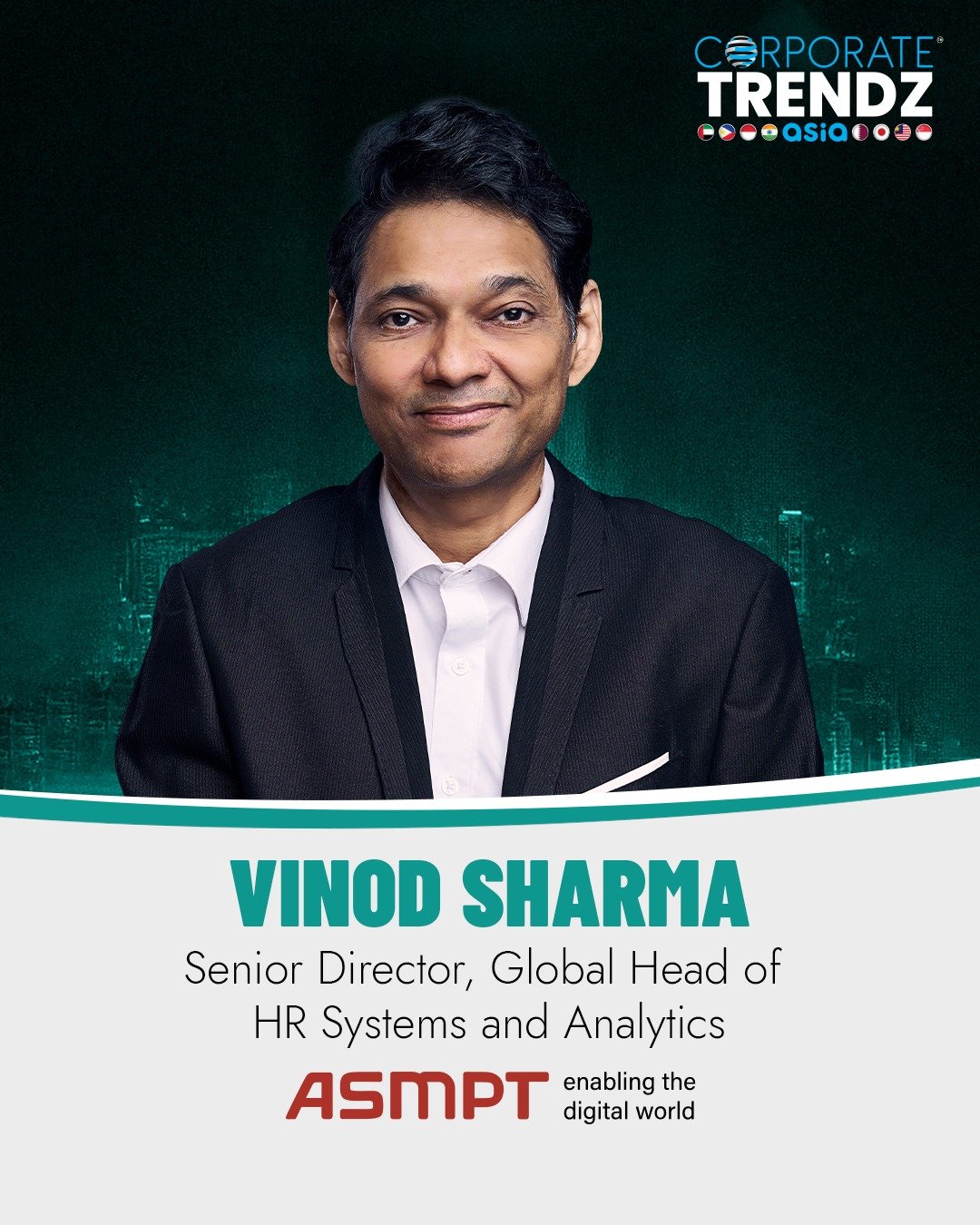
Vinod Sharma
Senior Director, Global Head of HR Systems & Analytics
ASMPT
“AI still seems like a Solution Looking for a Problem” — Mr. Vinod Sharma states with conviction, grounded in a clear belief in human capability and practical solutions. His leadership philosophy finds expression in his actions, with that consistency visible throughout a career defined by large-scale global HR transformations and a pioneering spirit that has repeatedly placed him ahead of the curve.
Transformation at
Scale — From PeopleSoft Pioneer to Global HR Architect
How a systems-first thinker is reimagining the future of work through Human-AI collaboration and enterprise-wide HR transformation.
“I believe in the future work will be redesigned around Human-AI collaboration. AI will ultimately become our digital colleague who does most of the work, and we will be the ones validating, adjusting, and approving it. The future of our work is a shift from us doing the task to us curating the outcome.”
Mr. Vinod Sharma is currently serving as Senior Director and Global Head of HR Systems and Analytics at ASMPT. He began his career along an unconventional path, choosing to specialise in an area that was largely unexplored at the time. In the 1990s, when most professionals gravitated toward ERP and finance platforms, he focused on HR systems — becoming one of the first professionals in India to be trained on PeopleSoft. That early decision positioned him to lead India’s first and largest HR system implementation at Unilever.
His career has since been defined by large-scale, complex global transformations. From architecting the world’s largest PeopleSoft project for the Government of Mexico to leading the largest Workday deployment in Asia for the Singapore Government, each milestone has deepened his expertise in transformation at scale and sharpened his strategic perspective on how technology and people intersect.
Recognised as one of the Most Inspiring HR Leaders in Asia 2026, Mr. Vinod Sharma shared that one of the biggest misconceptions in global transformations lies in the assumption that local practices should dominate design decisions. He emphasised the need to first establish clarity on the real objective of the exercise — noting that if it is truly an HR transformation, then local requirements, by definition, become secondary. The very purpose of such initiatives, he argues, is to move away from disparate regional practices toward a harmonised, company-wide way of working built on shared values.
In an exclusive interview with Corporate TrendZ, Mr. Vinod Sharma offered a bold vision for the future of work — one where Human-AI collaboration redefines roles rather than eliminates them. He sees AI not as a disruptor to be feared but as a digital colleague whose outputs humans will validate, refine, and direct. This shift — from task execution to outcome curation — sits at the heart of how he is preparing organisations for the next era of work.